Black Hole Explorer teams test subsystem prototypes

The Black Hole Explorer (BHEX) project is a space-based mission with the goal of capturing the sharpest images of supermassive black holes ever obtained. Currently under development, BHEX plans to launch an orbiting antenna that will observe at millimeter-wavelengths in concert with ground-based telescopes using a technique known as very long baseline interferometry (VLBI). (What is VLBI?) The images resulting from this telescope array will enable the measurement of several properties of supermassive black holes and capture the first-ever images of their photon rings—sharp, encircling rings of light produced by the intense gravity of the black hole. Development work on BHEX is being funded through support from the Gordon and Betty Moore Foundation and the project will be proposed as a NASA Small Explorer (SMEX) mission in mid-2026.
In December 2025, researchers from MIT Haystack Observatory worked together with colleagues from the Center for Astrophysics | Harvard & Smithsonian (CfA) and MIT Lincoln Laboratory to achieve an important technical readiness milestone for the BHEX project. BHEX is led by principal investigator Michael Johnson of the CfA. During a six-day collaborative test hosted at Haystack Observatory and Lincoln Laboratory, the teams assembled prototypes of the electronics components for BHEX, including laser communication systems, the digital backend (a component responsible for acquiring and digitizing the incoming signal), and high-speed data recorders.
“BHEX is designed to take us to the edge of a black hole, and that begins with mastering an extraordinary flow of data,” Johnson said. “In only a few seconds, we must capture and downlink as much data as the Hubble Space Telescope transmits in a week. These tests show that we can meet that challenge using a low-power laser downlink system together with the MIT Haystack supercomputer.”
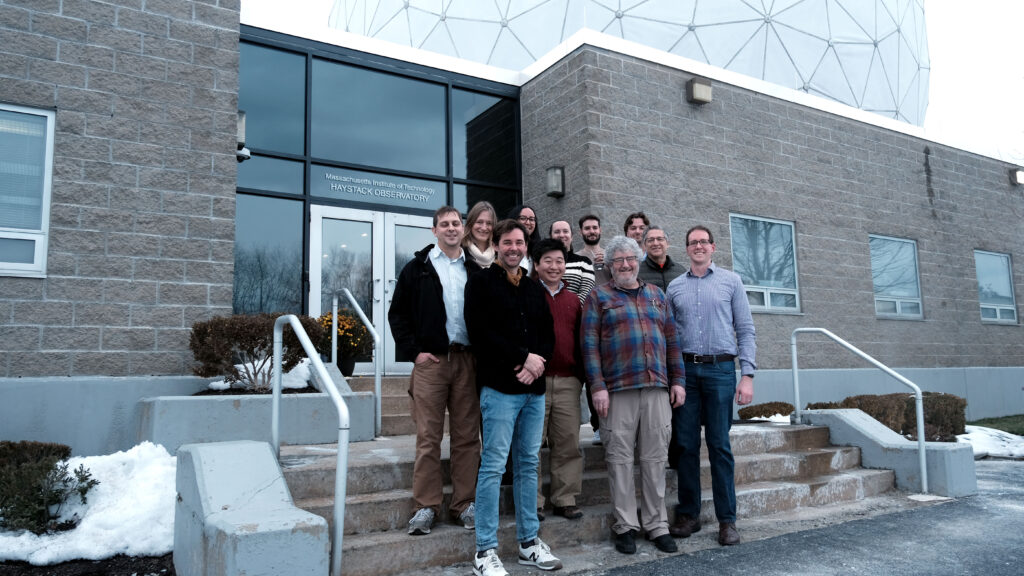
This collaborative experiment marks the first time these components were operated together in a connected and coordinated manner, as well as the first verified successful data transport from start to finish though the system. The various tests explored a wide variety of factors that are expected to impact the quality of data downlinked from the orbiting BHEX satellite and radio antenna system, including varying power levels and changing atmospheric conditions.
During the recent experiment, Haystack provided new recording technology to capture the data streams after they were transmitted through a laser communication emulator. The collected data sets were then processed by a specialized supercomputer at Haystack known as a VLBI correlator, providing the output products needed for verifying the data’s integrity and enabling further exploration and analysis.
A wide variety of measurements were collected during the test, some of which are still being analyzed. The results will inform future technological planning and development for the BHEX mission. Preliminary results indicate that the system as a whole functioned nominally, marking an important milestone for the project. Further work with these data will be helpful in extracting insight into how BHEX observations and the downlink of spacecraft data via a laser communication system should be scheduled in a future orbital mission.
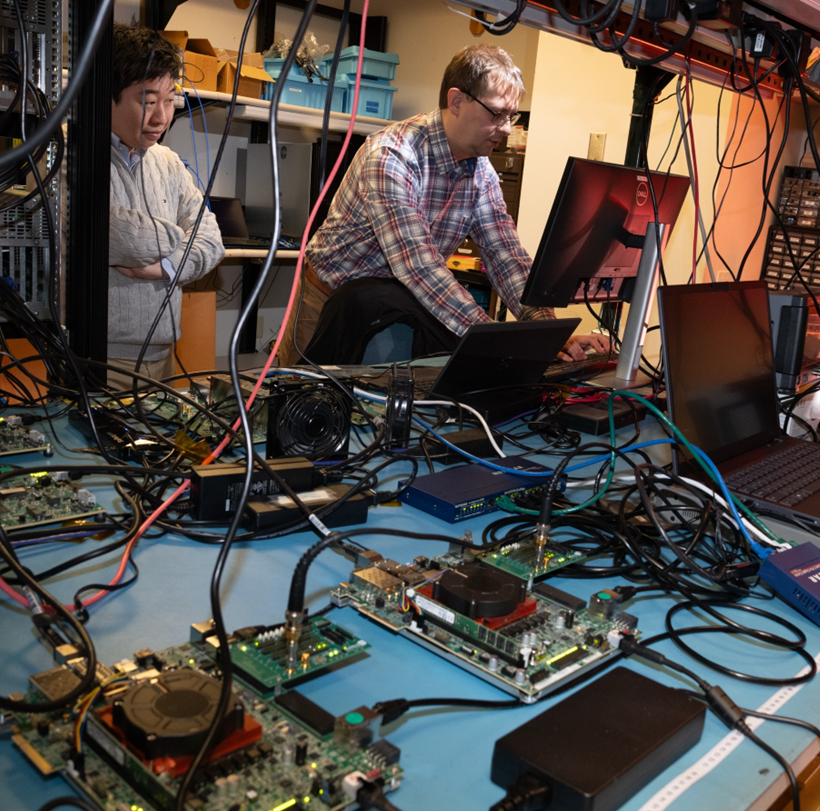
BHEX correlation lead Dan Hoak said, “VLBI is a complicated technique, with many technical details that have to be exactly correct in order for us to produce images of black holes. Use of an orbiting antenna, as with the BHEX mission, is adding another layer of complexity by requiring that we transfer large data volumes from space to ground with a laser communication system. These sorts of end-to-end tests of prototype systems are critical in the early stages of development to validate the methods we’ll use to develop the BHEX mission.”
This research was funded by the Gordon and Betty Moore Foundation, Grant GBMF12987.