Geospace scientists investigating fireball meteor above Cape Cod Bay
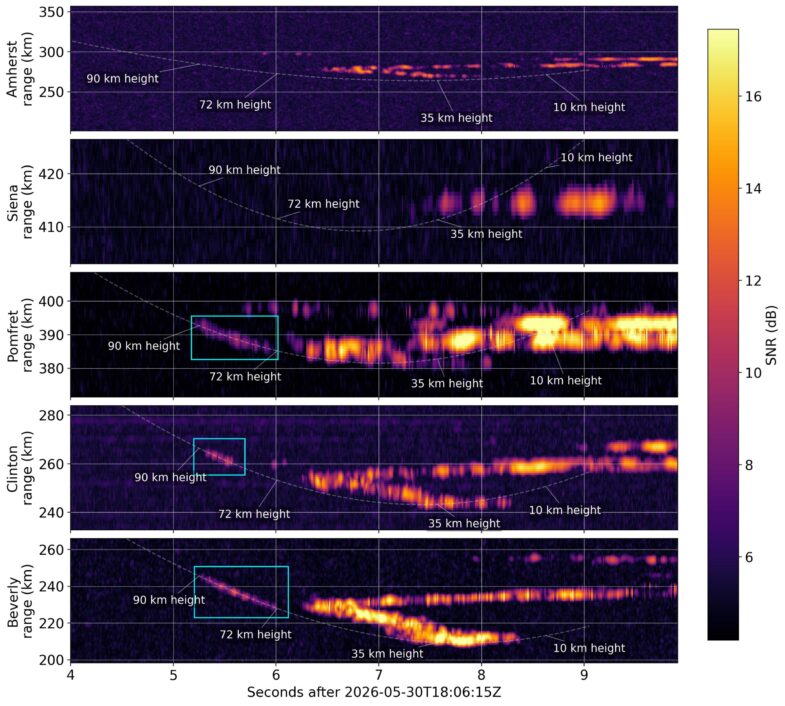
On May 30, 2026, a meteor above Cape Cod Bay exploded into a fireball. With a dramatic sonic boom, the meteor, or superbolide, broke up at at altitude of 31 miles and fell into Cape Cod Bay. Scientists from MIT Haystack Observatory are researching this event with a team including colleagues in the US, Germany, and Norway.
With data obtained from a very high frequency (VHF) meteor radar network, researchers from Haystack with their US and international collaborators have been studying the path and behavior of this meteor. A paper is currently in peer review for publication in The Astronomical Journal (Vierinen et al., in review). A better understanding of how the Earth’s atmosphere affects such meteors and precise measurements of such events is crucial for today’s society, in terms of their effects both on Earth and in space.
Scientist Ryan Volz works on meteor radar networks, including the Spread Spectrum Interferometric Meteor Observing Network (SIMONe) located at Haystack Observatory. SIMONe was developed by MIT, the Arctic University of Norway, and the Leibniz Institute of Atmospheric Physics in Kühlungsborn, Germany. “We got pretty lucky to observe this one,” Volz told Space.com. “A bolide like this would have to enter the atmosphere within about 62 miles (100 kilometers) of a SIMONe-like meteor radar system for the head echoes we saw to be detectable, and there are only a handful of places in the world that currently meet that criteria.”
“We got pretty lucky to observe this one.”
Ryan Volz, Haystack Observatory
Haystack Director Phil Erickson was recently interviewed by NPR Cape Cod (https://www.capeandislands.org/local-news/2026-11-05/international-team-of-scientists-studying-cape-cod-bay-fireball-event). “These studies . . . almost invariably lead to your better understanding of the fundamentals of the atmosphere. And as humans become a spacefaring society and people like SpaceX launch a whole bunch of satellites into low Earth orbit, the ability to understand our atmosphere is actually becoming a much more urgent need than it was even a decade ago,” said Erickson.
Publication details of this paper will be available here once it is published.