Ionospheric Techniques

The Millstone Hill Observatory maintains or hosts a variety of instrumenst for studuing
the Earth's ionosphere and upper Atmosphere. These are described below. The Atmospheric Sciences
Group is also active in several new initiatives, including ISIS, DASI and AMISR .
-
- ISR
- M.I.T. (Foster) [1965 - present].
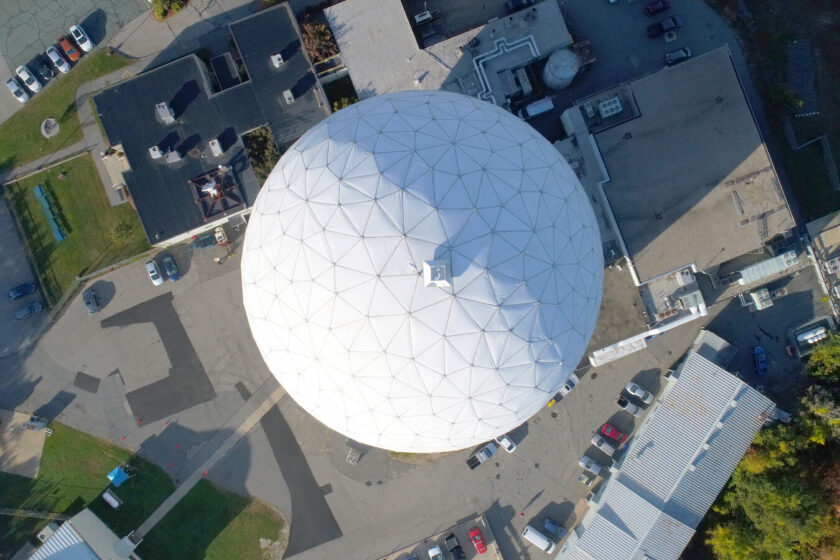
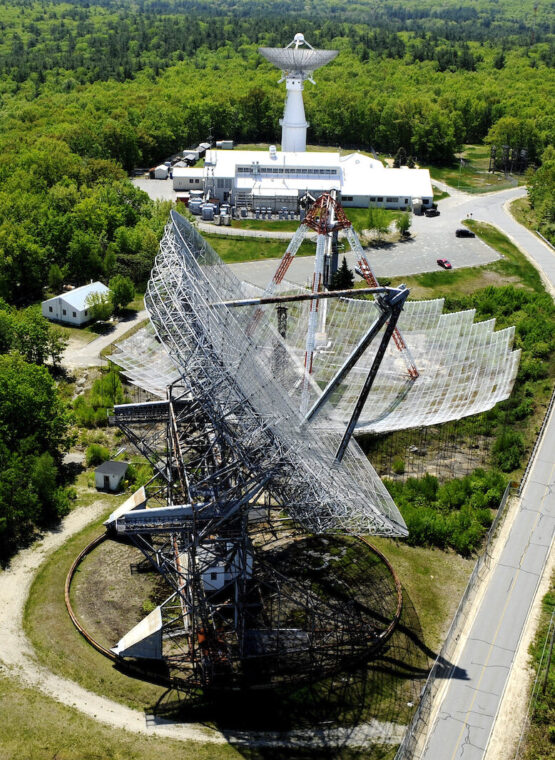
440 MHz, 2-5 MW, dual-transmitter
incoherent scatter radar.
68-m zenith and 46-m steerable parabolic antennas.
E and F region ionospheric studies; lower and upper thermosphere.
Operates 1000+ hours/year; supports
World Day
and CEDAR campaigns.
- Digisonde
- U. Massachusetts/Lowell (Reinisch) [1987 - present]. Digisonde Portable
Sounder (DPS-1) 0.5-30 MHz digital ionospheric sounder. 25-m rhombic 300
W transmit antenna; directional receiving array. Operates continuously
with 15-min resolution.
(Latest
Ionogram)
- All-Sky Imager
- Boston University
(Mendillo/Baumgardner) [1987 - present]. Image intensified TV camera.
Observes atomic oxygen lines (630 nm, 558 nm). Nightglow and SAR arc
studies. Operates 1 week either side of new moon.
- FPI
- MIT/U. Pittsburgh (Sipler/Biondi) [1989 - 2005].
100 mm field-widened Fabry-Perot interferometer.
Automated continuous observations of atomic oxygen 630 nm nightglow.
- GPS
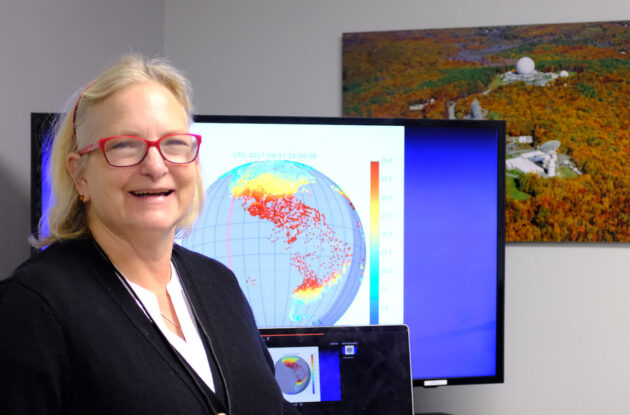
- MIT Lincoln Laboratory (Coster) [1991 - present]. A real-time synoptic
ionospheric monitoring system that predicts the total electron content
(TEC) in any direction around the radar site. These TEC measurements
extend out to the altitudes of GPS satellites, approx. 20,000 km.
- Imaging Spectrometer
- Boston University
(Mendillo/Baumgardner) [1992 - present].
Meridian slit dispersed by grating onto image intensified TV camera.
Observes spectrum of meridian slice for background measurements and
calibration of other instruments.
Operates 1 week either side of new moon.
- ASDI
- MIT/U. Pittsburgh (Sipler/Biondi)
[1993 - present].
All-Sky Doppler Interferometer consisting
of a Fabry-Perot interferometer coupled to an all-sky lens.
The image of the sky is superimposed on the interferometer ring
pattern so that each ring corresponds to a different elevation angle
on the sky. The detector is a back-thinned CCD, which has good quantum
efficiency up to around 900 nm. Filter wheel installed in 1997 with
filters for 630 nm, 558 nm oxygen lines and 800 nm OH line.
More information is available
here.
- CEDAR FPI
- MIT (Sipler) [1994 - present].
Fabry-Perot interferometer with broadband plate coatings covering
500 - 1000 nm. A back-thinned CCD detector will enable the instrument
to make measurements out to around 980 nm. Used for E-region
measurements of atomic oxygen green line (557.7 nm) and OH lines
in the D-region.
- MEASURE Magnetometer
- UCLA/IGPP; Mark Moldwin (UCLA) [1999 - present].
Millstone Hill is one of five stations on the NSF sponsored MEASURE
array, with a fluxgate magnetometer and GPS receiver designed to sample
the background terrestrial magnetic field variations at 1 Hz. The
MEASURE array studies ULF wave propagation, substorms, sudden impulses,
and other inner magnetospheric phemonena. Automated continuous
observations are made.
- Suominet
- UCAR/UNAVCO [2001 - present]. GPS and weather station. Part of a
distributed network of GPS observatories designed to observe ionospheric
TEC and atmospheric PWV. Operates all the time with 1 minute resolution
at 15 minute intervals. Data is available locally on
www.haystack.mit.edu/suominet.
- ARL CIDR Array
- ARL (Bust) [2002 - present]. Coherent Ionospheric Doppler Receiver array
deployed at the MIT
Haystack Observatory and available for observing satellite beacons for
TEC inversion and scintillation monitoring. A total of three receivers
are currently deployed with a fourth one waiting for a decision on a location.
Operates all the time. Currently data products may be requested from ARL.