Haystack 37m Telescope
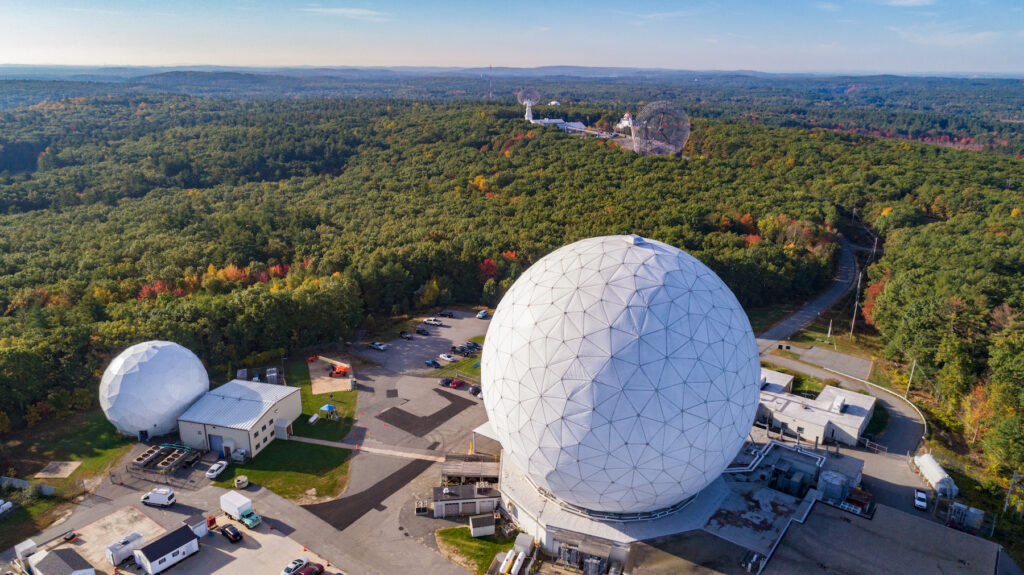
The Haystack 37m Telescope is a 37-meter (120-foot) radio dish located in Westford, Massachusetts, and operated for astronomy by MIT Haystack Observatory. It is enclosed in a protective radome 46 meters (150 feet) in diameter—the largest structure of this type in the world. The telescope observes the universe using radio waves, revealing phenomena that cannot be seen with optical telescopes.
Since its completion in 1964, Haystack Observatory has been a site of innovation in both science and engineering, supporting discoveries about planets, stars, galaxies, and the fundamental laws of physics. The Haystack 37m Telescope also plays a critical role in radar science through work led by MIT Lincoln Laboratory. Originally developed as a radar system, the instrument continues to support space situational awareness by imaging satellites and tracking objects in Earth orbit.
On this page, we provide information on the telescope and its enclosing radome. Information on technical details, as well as current and future research use of the instrument, is available at the Haystack 37m Telescope Astronomy Program page.
The Haystack 37m Telescope brochure (PDF)
What Makes Haystack Unique
- Protection from the elements: The telescope sits inside a large radome (more on this below), which shields it from wind and helps it recover more quickly from snow and ice.
- Exceptional precision: Its surface accuracy enables observations at millimeter wavelengths, probing fine details in the universe.
- Dual-purpose design: The instrument supports both scientific research and radar applications, making it one of the most versatile facilities of its kind.
- Accessible location: Located near Boston, the telescope provides rare hands-on opportunities for students and researchers in the United States.
Exploring the Universe
Scientists use the Haystack 37m Telescope to study some of the most fundamental questions in science.
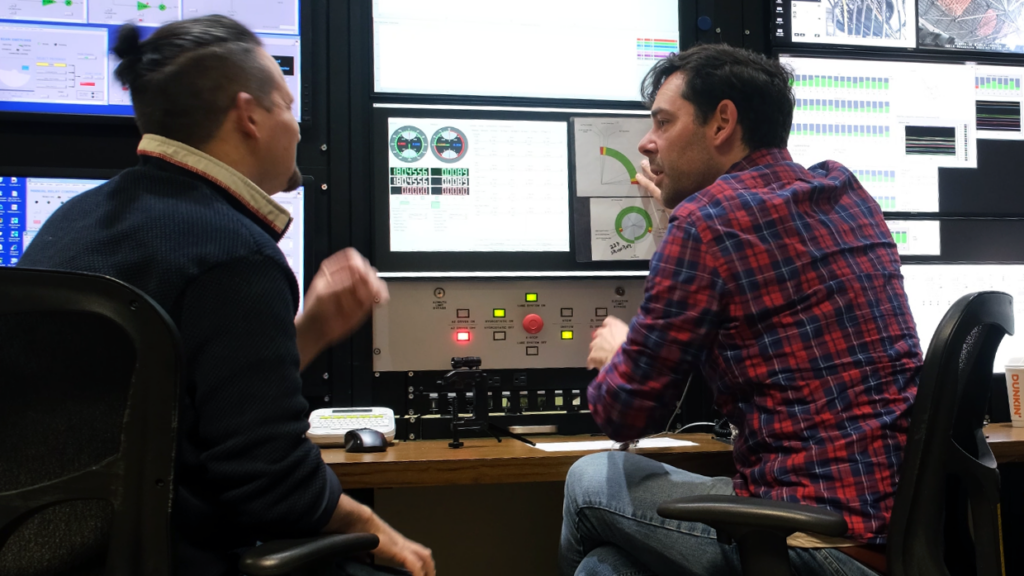
- Planetary defense: Observations help characterize near-Earth objects and support planetary defense efforts to understand potential hazards from asteroids that might impact Earth.
- Origins of stars and their planets: The telescope probes dense clouds of gas and dust where new stars and planetary systems are born.
- Black holes and extreme physics: As part of global telescope networks, Haystack contributes to studies of black holes and high-energy phenomena across the universe.
The telescope is currently equipped to operate at frequencies of 18–115 GHz, roughly corresponding to wavelengths between 3 millimeters and 2 centimeters. Detailed information about current research programs, educational activities, and technical capabilities is documented as part of the Haystack 37m Telescope Astronomy Program.
A Living Laboratory for Education
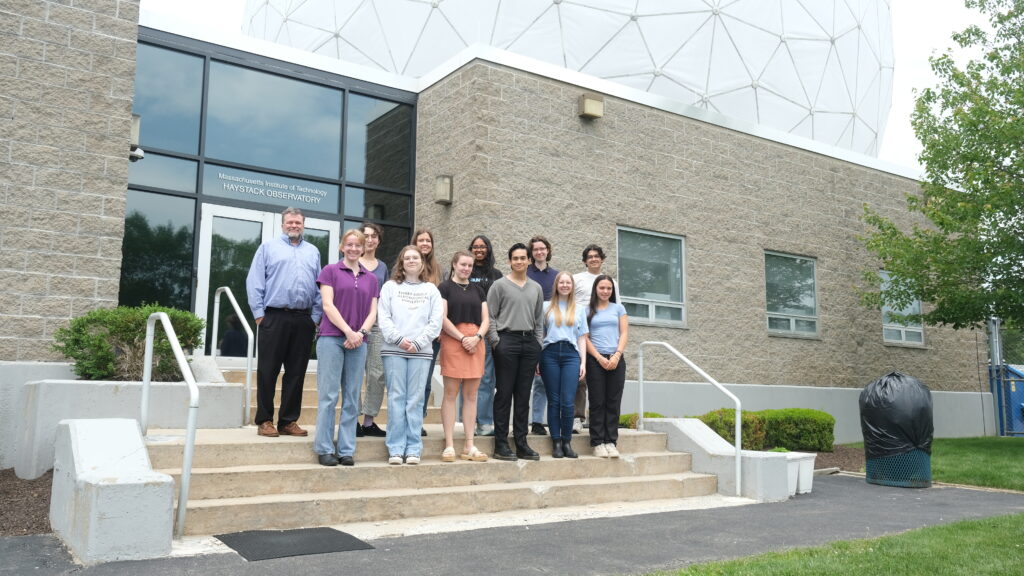
The Haystack 37m Telescope is more than a research instrument — it is a place where junior scientists learn by doing:
- Students work directly with real telescope systems, including the National Science Foundation–funded Research Experiences for Undergraduates (REU) program.
- Early-career researchers gain hands-on experience in instrumentation and data analysis.
- Programs connect universities and institutions across the northeast US through NEROC.
This combination of access, capability, and real-world engagement is rare worldwide and provides unique opportunities for education and training.
Radome and Telescope

The Haystack 37m Telescope is housed inside a striking spherical enclosure known as a radome—a combination of “radar” and “dome.” The dish itself is a precisely shaped parabolic antenna in a Cassegrain configuration, designed to collect faint radio signals from space. Surrounding it is a 46-meter (150-foot) radome made of 932 triangular panels of hydrophobic material that allow radio waves to pass through with minimal interference. It is the largest radome of its kind in the world.
The radome’s surface follows a complex geometric pattern called a trapezoidal hexecontahedron, chosen to provide strength while minimizing any blockage of incoming signals. Originally developed for harsh Arctic environments, the radome shields the telescope from wind and helps it recover quickly from snow and ice. This protective design allows the telescope to operate reliably in the varied and often challenging weather conditions of New England.
A Legacy of Innovation
Over the decades, the Haystack 37m Telescope has contributed to major advances in science and technology:
- Early tests of Einstein’s theory of general relativity
- Pioneering development of very long baseline interferometry (VLBI)
- Discovery and study of the environments where stars form
- High-resolution radar mapping of planets and space objects
These achievements reflect a long-standing collaboration between MIT Haystack Observatory and MIT Lincoln Laboratory.
Looking Ahead
Today, the Haystack 37m Telescope is entering a new era. With modern instrumentation and renewed scientific programs, it is once again enabling cutting-edge research while expanding opportunities for education and collaboration. This work is conducted as part of the Haystack 37m Telescope Astronomy Program.