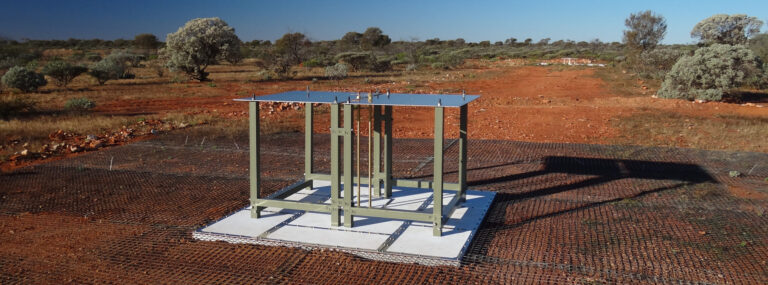
EDGES: Experiment to Detect the Global EoR Signature
EDGES 2025
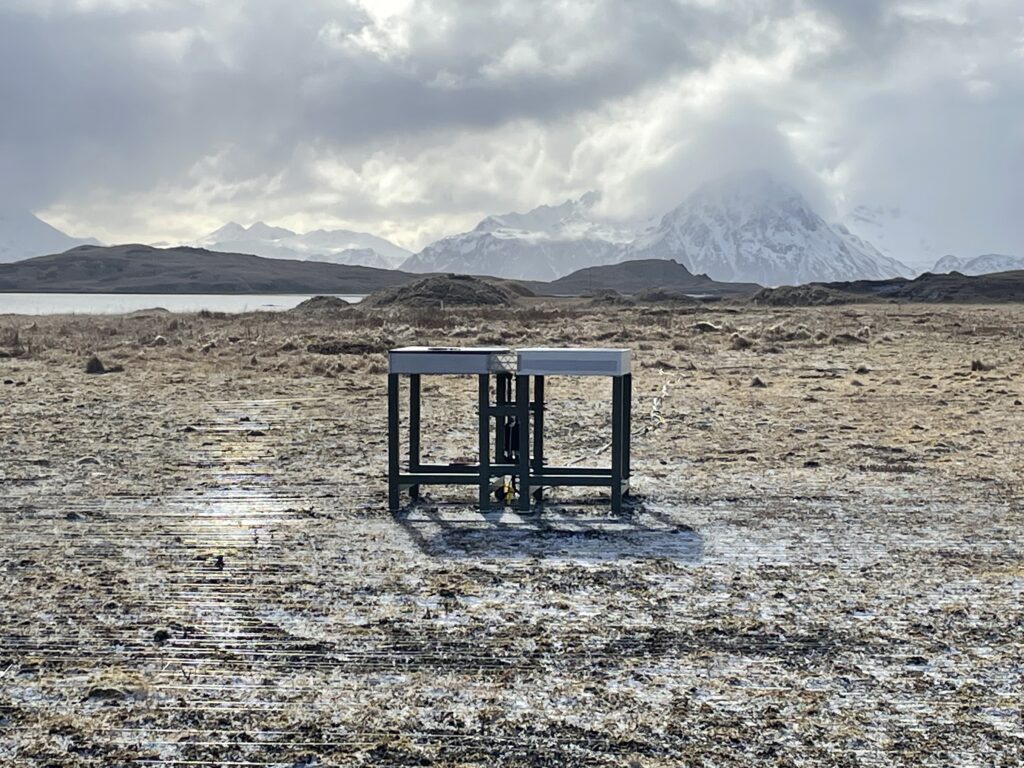
In December 2024, an EDGES system was deployed to Adak Island, which is located in the middle of the Aleutian Island chain of Alaska.
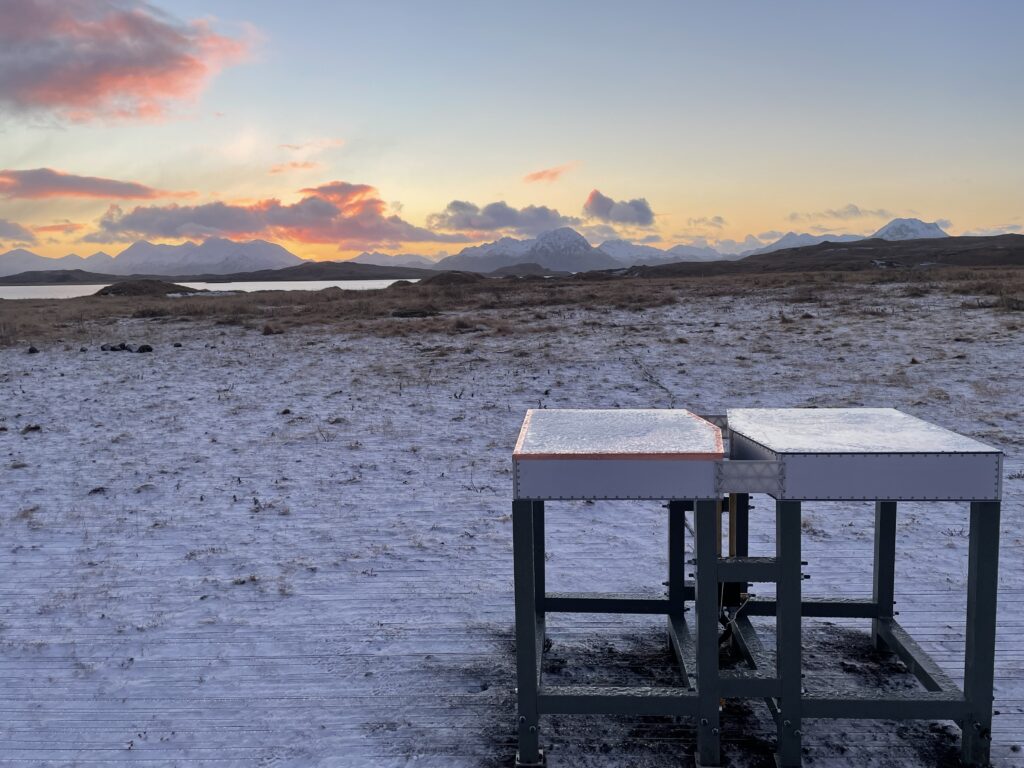
Adak Island is a northern hemisphere site that is hundreds of miles from any FM radio transmitters, making it an ideal location for a successful 21-cm global measurement. The system is currently still installed and operating there, collecting new data daily.
EDGES 2022–2024
A Haystack engineering team deployed the updated EDGES technology known as EDGES-3 to the remote—and radio-quiet—Devon Island in Nunavut, Canada, and obtained results consistent with the 2018 result, which were presented at the 7th Global 21-cm Workshop by Rigel Cappallo at the Raman Research Institute, Bengaluru, India in October 2024.
Aims and results
EDGES is a long-term collaboration between MIT Haystack Observatory and Arizona State University, funded by the National Science Foundation (NSF). It is located at the Murchison Radio-astronomy Observatory (MRO) in a radio-quiet zone in western Australia, with onsite infrastructure support provided by Australia’s CSIRO. The antennas and portions of the receiver were designed and constructed by MIT Haystack Observatory’s Dr. Alan Rogers and the Haystack team, working with project lead Judd Bowman, Raul Monsalve, and the ASU team.
A ground-breaking and widely cited EDGES result, “An absorption profile centred at 78 megahertz in the sky-averaged spectrum,” was published in Nature. This result, which must be independently confirmed by other research groups, has profound implications for our understanding of the early universe.
If you’re new to cosmology, watch this excellent NSF video that explains the significance of the EDGES observations:
An MIT News article on EDGES is available at http://news.mit.edu/2018/astronomers-detect-earliest-evidence-yet-hydrogen-universe-0228.
For more technical details about EDGES, please see the MIT Haystack EDGES memo series, and the ASU EDGES memo series.
The project’s goal is radio detection of characteristic hydrogen signatures from the periods in the early history of the universe known as Cosmic Dawn—when the first stars were born, and the Epoch of Reionization (EoR)—when stars and galaxies generated radiation that eroded and eventually destroyed the neutral hydrogen. For an extensive scientific explanation of the cosmological mysteries that EDGES is designed to probe, see this article from ASU.
EDGES technology
The EDGES instrument comprises a small, simple antenna sitting on a large metal sheet (or “ground plane”), with a receiver system, spectrometer, and highly precise calibration components. The measurement is easily corrupted by radio frequency interference, so the system is sited in remote western Australia, in a radio-quiet reserve known as the Murchison Radio-astronomy Observatory (MRO). The signal being sought is a tiny perturbation against a sky that is extremely bright at the observing frequencies of interest, and can be detected only if the instrument is exquisitely well calibrated. The technological innovation is almost entirely focused on this formidable calibration challenge.
The signal is caused by neutral hydrogen, which naturally emits and absorbs radiation at a frequency of 1420 MHz, or a wavelength of 21 cm. Due to the expansion of the universe, signals from Cosmic Dawn and the EoR are red-shifted to low frequencies and wavelengths of a few meters, which is where the EDGES system operates. There are multiple versions of the system — “low-band,” “mid-band,” and “high-band” — that together cover the 50–200 MHz range. The low-band system broadband antenna is about 2 meters long and 1 meter high, and the metal ground plane is 30 by 30 meters. There are three generations of the system—the Nature result was obtained with EDGES-II, and the new EDGES-III system promises increased precision.
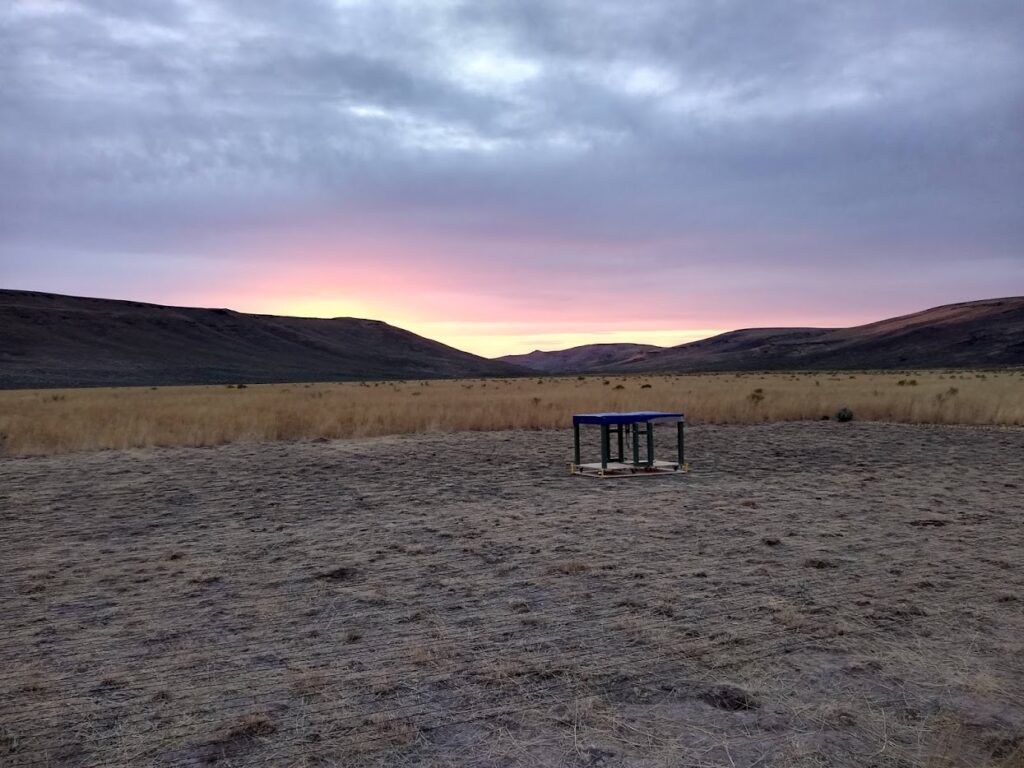
The EDGES calibration system is based on switching known sources of noise in and out of the signal path, and precise measurement of the strength and properties of internal reflections in the various system components. One innovation in the EDGES-III system is to perform all these functions in the field, instead of the EDGES-II approach of doing the reflection measurements in the laboratory, before and after each deployment. The data analysis is complex, and depends on extreme smoothness of the instrument response with frequency. Detection relies on the signal being “not smooth” in frequency, and on persistence against a broad range of instrumental and observational configurations and parameters.
All technical details of the project are described in great detail in the MIT Haystack EDGES memo series.
The antennas and portions of the receiver were designed and constructed by MIT Haystack Observatory’s Dr. Alan Rogers and the Haystack team; Judd Bowman, Raul Monsalve, and the ASU team added an automated antenna reflection measurement system to the receiver, outfitted the control hut with the electronics, constructed the ground plane, and conducted the field work for the project. Australia’s Commonwealth Scientific and Industrial Research Organization (CSIRO) provides on-site infrastructure for the EDGES project.
There is a great technical challenge to making this detection. Sources of noise can be a thousand times brighter than the signal they are looking for. It is like being in the middle of a hurricane and trying to hear the flap of a hummingbird’s wing.
Peter Kurczynski, program director for Advanced Technologies and Instrumentation, in the Division of Astronomical Sciences at the National Science Foundation, which has provided funding for the project over the past several years
Haystack project team
Publications
Cappallo, R.C., Rogers, A.E., Lonsdale, C.J., Bowman, J.D., Barrett, J.P., Murray, S.G., Mahesh, N., Sims, P., Vydula, A.K., Monsalve, R.A. and Eckert, C.J., 2025. EDGES-3: Instrument Design and Commissioning. Publications of the Astronomical Society of the Pacific, 137(12), p. 125002. https://doi.org/10.1088/1538-3873/ae1bd6
Vydula, A.K., Bowman, J.D., Lewis, D., Crawford, K., Kolopanis, M., Rogers, A.E., Murray, S.G., Mahesh, N., Monsalve, R.A., Sims, P. and Samson, T., 2023. Low-Frequency Radio Recombination Lines Away From the Inner Galactic Plane. The Astronomical Journal, Volume 167, Number 1 Citation Akshatha K. Vydula et al 2024 AJ 167 2. https://doi.org/10.48550/arXiv.2302.14185
Sims, P.H., Bowman, J.D., Mahesh, N., Murray, S.G., Barrett, J.P., Cappallo, R., Monsalve, R.A., Rogers, A.E., Samson, T. and Vydula, A.K., 2023. A Bayesian approach to modelling spectrometer data chromaticity corrected using beam factors–I. Mathematical formalism. Monthly Notices of the Royal Astronomical Society, 521(3), pp.3273-3297. https://doi.org/10.1093/mnras/stad610
Rogers, A.E., Barrett, J.P., Bowman, J.D., Cappallo, R., Lonsdale, C.J., Mahesh, N., Monsalve, R.A., Murray, S.G. and Sims, P.H. (2022) Analytic approximations of scattering effects on beam chromaticity in 21‐cm global experiments. Radio Science, p.e2022RS007558. https://doi.org/10.1029/2022RS007558
Murray, S.G., Bowman, J.D., Sims, P.H., Mahesh, N., Rogers, A.E.E., Monsale, R.A., Samson, T., and Vydula, A.K. (2022) A Bayesian calibration framework for EDGES. Monthly Notices of the Royal Astronomical Society 517(2): 2264–2284. https://doi.org/10.1093/mnras/stac2600
Mahesh, Nivedita, Judd D. Bowman, Thomas J. Mozdzen, Alan EE Rogers, Raul A. Monsalve, Steven G. Murray, and David Lewis. (2021) Validation of EDGES Low-Band Antenna Beam Model. The Astronomical Journal 162, no. 2: 38. https://doi.org/10.3847/1538-3881/abfdab
Monsalve, Raul A., Alan E.E. Rogers, Judd D. Bowman, Nivedita Mahesh, Steven G. Murray, Thomas J. Mozdzen, Leroy Johnson, John Barrett, Titu Samson, and David Lewis. (2021) Absolute Calibration of Diffuse Radio Surveys at 45 and 150 MHz. The Astrophysical Journal 908, no. 2: 145. https://doi.org/10.3847/1538-4357/abd558
Monsalve, R.A., A. Fialkov, J.D. Bowman, A.E.E. Rogers, T.J. Mozdzen, A. Cohen, R. Barkana, N. Mahesh. (2019) Results from EDGES High-Band. III. New Constraints on Parameters of the Early Universe, ApJ, 875, 67. https://doi.org/10.3847/1538-4357/ab07be
Bowman, Judd D., Alan E.E. Rogers, Raul A. Monsalve, Thomas J. Mozdzen, and Nivedita Mahesh. (2018) Reply to Hills et al. Nature 564: E32–E34. https://doi.org/10.1038/s41586-018-0797-4
Mozdzen, T.J., N Mahesh, R A Monsalve, A.E.E Rogers, J.D. Bowman (2018). Spectral Index of the Diffuse Radio Background Between 50 and 100 MHz Monthly Notices of the Royal Astronomical Society, sty3410. https://doi.org/10.1093/mnras/sty3410
Monsalve, R.A., Bradley Greig, Judd D. Bowman, Andrei Mesinger, Alan E.E. Rogers and Thomas J. Mozdzen, Nicholas S. Kern and Nivedita Mahesh. (2018). Results from EDGES High-band. II. Constraints on Parameters of Early Galaxies, The Astrophysical Journal 863, no 1. https://doi.org/10.3847/1538-4357/aace54
Monsalve, Raul A., Alan E.E. Rogers, Judd D. Bowman, and Thomas J. Mozdzen (2017). Results from EDGES High-band. I. Constraints on Phenomenological Models for the Global 21 cm Signal. The Astrophysical Journal 847, no. 1 (2017): 64. https://doi.org/10.3847/1538-4357/aa88d1
Bowman, Judd D., Rogers, Alan E.E., Monsalve, Raul A., Mozdzen, Thomas J., and Mahesh Nivedita. (2018). An absorption profile centred at 78 megahertz in the sky-averaged spectrum. Nature 555, 67–70. https://doi.org/10.1038/nature25792
Monsalve, R.A., Rogers, A.E.E., Bowman, J.D., and Mozden, T.J. (2017). Calibration of the EDGES high-band receiver to observe the global 21 cm signature from the Epoch of Reionization. Astrophysical Journal 835(1), 49. http://dx.doi.org/10.3847/1538-4357/835/1/49
Monsalve, R.A., Rogers, A.E.E., Mozdzen, T.J., and Bowman, J.D. (2016). One-port direct/reverse method for characterizing VNA calibration standards. IEEE Transactions on Microwave Theory and Techniques 64(8): 2631–2639. https://arxiv.org/pdf/1606.02446
Mozdzen, Thomas J., Judd D. Bowman, Raul A. Monsalve, and Alan E.E. Rogers (2016). Improved measurement of the spectral index of the diffuse radio background between 90 and 190 MHz. Monthly Notices of the Royal Astronomical Society 464(4): 4995–5002. https://doi.org/10.1093/mnras/stw2696
Rogers, A.E.E., Bowman, J.D., Vierinen, J., Monsalve, R. and Mozdzen, T. (2015). Radiometric measurements of electron temperature and opacity of ionospheric perturbations. Radio Sci., 50, 130–137. https://doi.org/10.1002/2014RS005599
Mozdzen, T.J., Bowman, J.D., Monsalve, R.A., Rogers, A.E.E. (2015). Limits on foreground subtraction from chromatic beam effects in global redshifted 21cm measurements. Monthly Notices of the Royal Astronomical Society 2015 455(4): 3890–3900. https://doi.org/10.1093/mnras/stv2601
Rogers, A.E.E., Bowman, J.D. (2012). Absolute calibration of a wideband antenna and spectrometer for accurate sky noise temperature measurements. Radio Science 47, RS0K06. https://doi.org/10.1029/2011RS004962
Bowman, J.D., Rogers, A.E.E. (2010). A lower limit of Δz > 0.06 for the duration of the reionization epoch. Nature 468, pp. 796-797. https://doi.org/10.1038/nature09601
Rogers, A.E.E., Bowman, J.D. (2008). Spectral Index of the Diffuse Radio Background Measured from 100 to 200 MHz. AJ 136(2), pp. 641-648. https://iopscience.iop.org/article/10.1088/0004-6256/136/2/64
Bowman, J.D., Rogers, A.E.E. Hewitt, J.N. (2008). Toward empirical constraints on the global redshifted 21 cm brightness temperature during the Epoch of Reionization. Ap.J. 676(1), 1–9. https://iopscience.iop.org/article/10.1086/528675