TechnologyObserving FacilitiesEducation and OutreachAbout Haystack

Storms

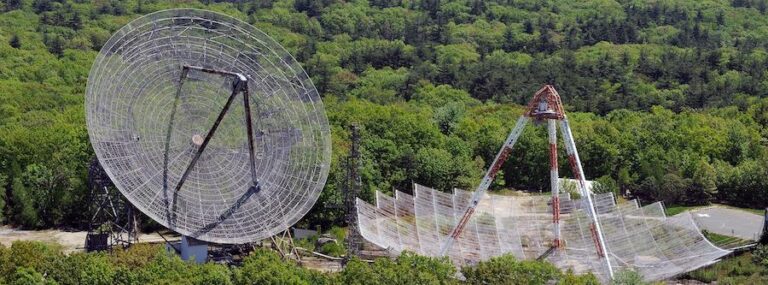
The Millstone Hill Observatory is located at the boundary between mid latitudes where ionospheric characteristics are largely solar production-dominated, and auroral latitudes where magnetospheric processes couple strongly to the ionosphere and modify its characteristics. During geomagnetic disturbances and solar-induced magnetospheric storms, the low-latitude extent of strong magnetospheric influence expands equatorward, bringing this dynamic M-I coupling region into the near field of view of the Haystack facility. The pronounced effects of stormtime processes, and their space weather consequences over the continental USA, are presented for close-range study by the powerful Haystack radar facilities. Accordingly, the Atmospheric Sciences Group at Haystack has placed an emphasis on experimental operations during major storm events and has responded quickly to storm alerts with experimental operations designed to classify and better understand the storm effects. Over the extent of several solar cycles a sizable database of stormtime observations has been collected and analyzed.

Detailed studies have addressed ionospheric storm effects at mid latitudes (e.g. Buonsanto et al. [1992]; Goncharenko et al. [2005]), and a compilation of these studies has led to a system-wide overview of the impacts of such storms at ionospheric heights [e.g. Buonsanto, 1999]. During the course of such work, new phenomena have been observed and identified, including storm enhanced density (SED [Foster 1993]) and the regular enhancement of the sub-auroral electric field in the Sub-Auroral Polarization Stream (SAPS) [Yeh et al., 1991; Foster and Burke, 2002]. The repeatable nature of the storm effects has been addressed in statistical studies using the long-duration database (Madrigal) of Millstone Hill radar observations (e.g. Vo and Foster [2001]; Foster and Vo [2002]).

Other instruments have been brought to bear on these investigations, including coherent radar, DMSP and other satellite overflight data, GPS TEC, and ground-based ionosonde observations. These multi-instrument and multi-site investigations are used to develop a global view of how local storm perturbations fit into large-scale picture of the upper atmosphere response to the extreme solar wind forcing which drives such storms.

Buonsanto, M. J., J. C. Foster, D. P. Sipler, Observations From Millstone Hill During the Geomagnetic Disturbances of March and April 1990, J. Geophys. Res., 97, 1225-1243, 1992.

Buonsanto, M. J., Ionospheric storms- A review, Space Science Reviews, 88, 563-601, 1999.

Goncharenko L., J. E. Salah, A. Van Eyken, V. Howells, J. P. Thayer, V. I. Taran, B. Shpynev, Q. Zhou, J. Chau, Observations of the April 2002 Geomagnetic Storm by the Global Network of Incoherent Scatter Radars, Annal. Geophys., v. 23, 163-181, 2005.

Foster, J. C., Storm-Time Plasma Transport at Mid and High Latitudes, J. Geophys. Res., 98, 1675-1689, 1993.

Yeh, H.-C., J. C. Foster, F. J. Rich, and W. Swider, Storm Time Electric Field Penetration Observed at Mid-latitude, J. Geophys. Res., 96, 5707-5721, 1991.

Foster, J. C., and W. J. Burke, SAPS: A New Categorization for Sub-auroral Electric Fields, EOS, 83, 393-394, 2002. Vo, H. B, and J. C. Foster, Quantitative investigation of ionospheric density gradients at mid latitudes, J. Geophys. Res., 106, 21555-21563, 2001.

Foster, J. C., and H. B. Vo, Average Characteristics and Activity Dependence of the Subauroral Polarization Stream, J. Geophys. Res., 10.1029/2002JA009409, 2002.

HOME  |  CONTACT  |  DIRECTIONS  |  WEATHER  |  INTRANET  |  SITEMAP  |  SEARCH
Astronomy

Science

Haystack Radio Telescope

Wideband VLBI

Radio Arrays (MWA, SKA, MAPS, Deuterium)

Small Radio Telescope (SRT)

Publications

Geodesy

Science

Westford Radio Telescope

Mark 4 VLBI Correlator

VLBI Technique Development

International VLBI Service (IVS)

Publications

Atmospheric Sciences

Science

Millstone Hill Observatory

Madrigal

Array Systems

Open Source Projects

Space Science Resources

Publications

Technology

Radio Arrays (MWA, SKA, MAPS, Deuterium)

Very Long Baseline Interferometry (VLBI)

Ionospheric Techniques

Open Source Projects

Observing Facilities

Haystack Radio Telescope

Westford Radio Telescope

Millstone Hill Radar

Deuterium Array

Atmospheric Optics Facility

Education and Outreach

Undergraduate Research

Research Experiences for Undergraduates (REU)

Research Experiences for Teachers (RET)

Pre-College Resources

Public Outreach Activities

About Haystack

Northeast Radio Observatory Corp. (NEROC)

Publications

News Archive

Glossary

Staff

Positions Available

Art at Haystack

History

Computing

Library

Networks

Safety Manual

Seminars

CloseSEARCH: